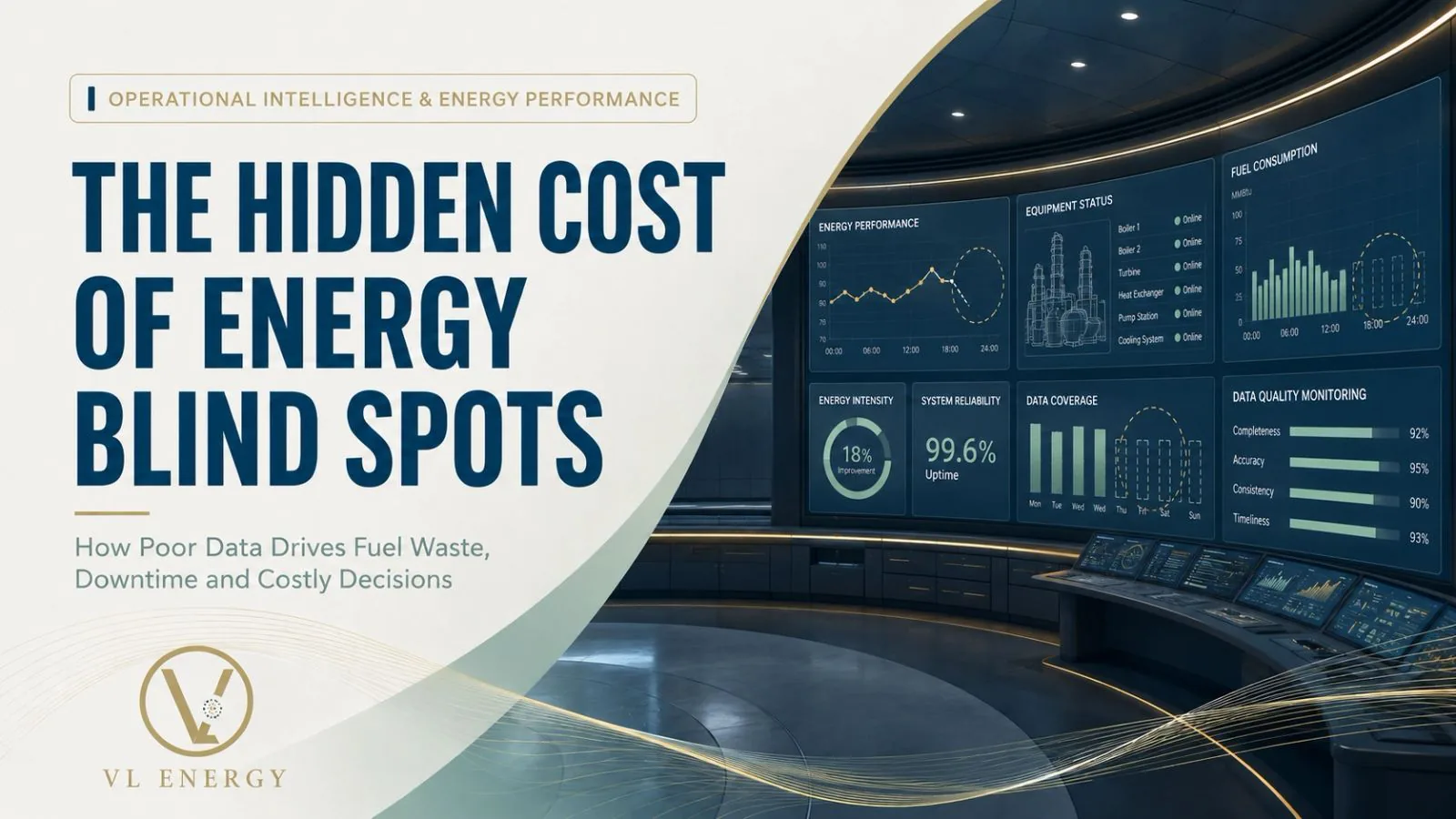
Industrial facilities generate enormous amounts of operational data. Yet many still lack a clear, real-time understanding of where energy is being used, where efficiency is being lost, and when equipment begins to operate outside its optimal range.
These gaps are energy blind spots, and they may be costing more than expected.
What Is an Energy Blind Spot?
An energy blind spot occurs when a facility cannot clearly connect its energy consumption with specific equipment, operating conditions, production levels, or maintenance events.
This often happens when:
- Energy data is incomplete, delayed, or stored across disconnected systems.
- Sensors provide unreliable or inconsistent readings.
- Operators rely on monthly utility bills instead of real-time performance data.
- Energy use is monitored without clear benchmarks or alerts.
- Efficiency opportunities are identified but not assigned or tracked.
The facility may continue operating, but inefficiencies remain hidden until they appear as higher fuel costs, equipment problems, or unexpected downtime.
The Real Cost of Missing or Unreliable Data
1. Fuel Waste Becomes "Normal"
A gradual increase in fuel consumption may not trigger immediate concern. However, small efficiency losses across boilers, compressors, generators, furnaces, or other energy-intensive equipment can accumulate into significant operating costs.
Without reliable performance baselines, abnormal energy use can easily be mistaken for normal variation.
2. Equipment Problems Are Detected Too Late
Changes in energy consumption can be an early warning sign of equipment degradation.
A compressor drawing more power, a boiler requiring additional fuel, or a generator operating below its expected efficiency may indicate developing mechanical or operational issues. When these changes are not detected early, facilities lose the opportunity to intervene before they lead to downtime or costly repairs.
3. Decisions Are Based on Incomplete Information
When data is missing, inconsistent, or difficult to interpret, teams are forced to rely on assumptions.
This makes it harder to:
- Prioritize energy-efficiency projects.
- Verify whether operational changes produced results.
- Support capital investment decisions.
- Identify the root cause of performance issues.
- Demonstrate progress toward energy and emissions targets.
More data does not automatically lead to better decisions. The data must be reliable, contextualized, and connected to action.
Closing the Gap with a Monitoring and Action Loop
Addressing energy blind spots does not require overwhelming operators with another dashboard. It requires a practical loop that turns operational data into measurable action.
Monitor
Collect energy and operating data from existing meters, sensors, control systems, and production records.
Validate
Identify missing, inconsistent, or low-confidence data before it influences operational decisions.
Detect
Compare current performance against expected operating conditions to identify abnormal consumption, efficiency losses, and emerging equipment issues.
Act
Provide clear, prioritized recommendations and assign responsibility for follow-up.
Verify
Measure the outcome to confirm whether the action reduced energy use, improved performance, or prevented further deterioration.
This continuous loop transforms energy management from a periodic reporting exercise into an active operational process.
Turning Industrial Data into Operational Value
VL Energy's ES-OptiEnergy platform helps industrial operators identify hidden energy losses and translate complex operational data into practical actions.
By integrating with existing facility systems, ES-OptiEnergy can help teams:
- Monitor energy performance in near real time.
- Detect inefficient or abnormal operating conditions.
- Identify unreliable sensor data.
- Benchmark equipment and process performance.
- Prioritize energy-saving opportunities.
- Assign and track corrective actions.
- Verify energy, cost, and emissions improvements.
The objective is not simply to visualize energy consumption. It is to give operators and management teams the information they need to make faster, better-informed decisions.
You Cannot Improve What You Cannot See
Energy blind spots rarely appear as one dramatic failure. More often, they show up as small, persistent losses: slightly higher fuel consumption, gradually declining equipment performance, recurring maintenance issues, and missed efficiency opportunities.
Over time, those losses add up.
By creating a reliable connection between monitoring, operational insight, action, and verification, industrial facilities can reduce waste, improve reliability, and make energy performance a manageable part of everyday operations.
Ready to uncover the energy blind spots in your facility? Connect with VL Energy to learn how ES-OptiEnergy can help turn your operational data into measurable energy and cost savings.